

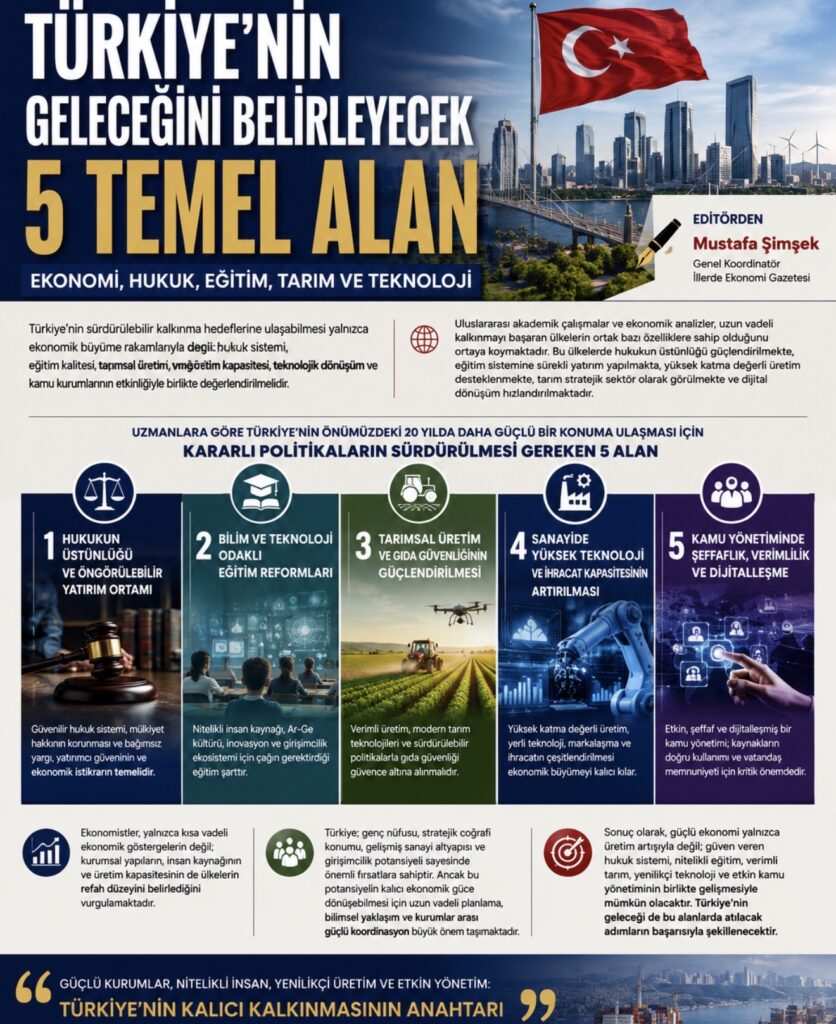
Editörden | Mustafa Şimşek
Genel Koordinatör – İllerde Ekonomi Gazetesi
Türkiye’nin sürdürülebilir kalkınma hedeflerine ulaşabilmesi, yalnızca ekonomik büyüme rakamlarıyla değil; hukuk sisteminin güvenilirliği, eğitim kalitesi, tarımsal üretim kapasitesi, teknolojik dönüşüm gücü ve kamu kurumlarının etkinliğiyle birlikte değerlendirilmelidir.
Uluslararası akademik çalışmalar ve ekonomik analizler, uzun vadeli kalkınmayı başaran ülkelerin ortak bazı temel özelliklere sahip olduğunu göstermektedir. Bu ülkelerde hukukun üstünlüğü güçlendirilmekte, eğitim sistemine sürekli yatırım yapılmakta, yüksek katma değerli üretim desteklenmekte, tarım stratejik bir sektör olarak ele alınmakta ve dijital dönüşüm devlet politikası haline getirilmektedir.
Uzmanlara göre Türkiye’nin önümüzdeki 20 yılda küresel rekabette daha güçlü bir konuma ulaşabilmesi için özellikle şu beş alanda kararlı, planlı ve sürdürülebilir politikalar geliştirmesi büyük önem taşımaktadır:
- Hukukun üstünlüğü ve öngörülebilir yatırım ortamı
- Bilim, teknoloji ve üretim odaklı eğitim reformları
- Tarımsal üretim ve gıda güvenliğinin güçlendirilmesi
- Sanayide yüksek teknoloji ve ihracat kapasitesinin artırılması
- Kamu yönetiminde şeffaflık, verimlilik ve dijitalleşme
Ekonomistler, ülkelerin refah seviyesini yalnızca kısa vadeli ekonomik göstergelerin değil; güçlü kurumların, nitelikli insan kaynağının, üretim kapasitesinin ve toplumsal güven ortamının belirlediğini vurgulamaktadır.
Türkiye; genç nüfusu, stratejik coğrafi konumu, gelişmiş sanayi altyapısı, tarımsal potansiyeli ve girişimcilik kabiliyetiyle önemli fırsatlara sahiptir. Ancak bu potansiyelin kalıcı ekonomik güce dönüşebilmesi için uzun vadeli planlama, bilimsel yaklaşım, liyakat esaslı yönetim ve kurumlar arası güçlü koordinasyon gerekmektedir.
Sonuç olarak güçlü bir ekonomi, yalnızca üretim artışıyla değil; güven veren hukuk sistemi, nitelikli eğitim, verimli tarım, yenilikçi teknoloji ve etkin kamu yönetiminin birlikte gelişmesiyle mümkün olacaktır. Türkiye’nin geleceği de bu beş temel alanda atılacak kararlı ve gerçekçi adımların başarısıyla şekillenecektir.
Five Key Pillars That Will Shape Türkiye’s Future: Economy, Rule of Law, Education, Agriculture, and Technology
Editorial | Mustafa Şimşek
General Coordinator – İllerde Ekonomi Newspaper
Türkiye’s ability to achieve its sustainable development goals should be evaluated not only through economic growth figures but also through the reliability of its legal system, the quality of its education, the capacity of its agricultural production, the strength of its technological transformation, and the effectiveness of its public institutions.
International academic studies and economic analyses indicate that countries achieving long-term and sustainable development share several common characteristics. These nations strengthen the rule of law, continuously invest in education, promote high value-added production, recognize agriculture as a strategic sector, and make digital transformation a core element of national policy.
According to experts, if Türkiye is to strengthen its position in global competition over the next two decades, it will be essential to pursue determined, well-planned, and sustainable policies in the following five key areas:
- Strengthening the rule of law and creating a predictable investment environment
- Implementing science, technology, and production-oriented education reforms
- Enhancing agricultural production and ensuring food security
- Expanding high-technology manufacturing and increasing export capacity
- Promoting transparency, efficiency, and digital transformation in public administration
Economists emphasize that a nation’s prosperity is determined not only by short-term economic indicators but also by the strength of its institutions, the quality of its human capital, its productive capacity, and the level of public trust within society.
Türkiye possesses significant advantages through its young population, strategic geographical location, advanced industrial infrastructure, agricultural potential, and entrepreneurial spirit. However, transforming this potential into sustainable economic strength requires long-term planning, a science-based approach, merit-based governance, and strong coordination among public institutions.
Ultimately, a strong economy cannot be achieved solely through increased production. It depends equally on a trustworthy legal system, high-quality education, productive agriculture, technological innovation, and an effective public administration. Türkiye’s future will be shaped by the determination and success with which these five strategic pillars are developed and implemented.